New 2026 Research Explores Why Supernatural Beliefs Persist as Traditional Religion Declines in Britain
Written by Kevin Mack | Founder of Paraghosts.com, Paranormal Investigator, Researcher, and Writer with 15+ Years of Experience | November 21, 2026
New research from the United Kingdom reveals how religious beliefs, personal supernatural experiences, and declining religious participation help explain why people continue believing in the paranormal.
Disclaimer: This article is intended for educational and informational purposes only. It discusses peer-reviewed research on paranormal beliefs and reported supernatural experiences. The findings identify statistical relationships and do not prove the existence of ghosts, spirits, or other paranormal phenomena. Personal experiences and interpretations may vary.
Introduction
Discover why people believe in the paranormal as new 2026 peer-reviewed research reveals surprising links between supernatural beliefs, religion, and secular society.
Why do people believe in the paranormal when traditional religion is declining? A new peer-reviewed study suggests that the answer is more complicated than simply believing or not believing in the supernatural.
Published on November 6, 2026, in the Journal for the Scientific Study of Religion, the research examines the relationship between organized religion and paranormal beliefs in the United Kingdom.
The researchers discovered an interesting pattern. People who believed in religious supernatural concepts were more likely to report paranormal beliefs.
However, people with stronger conventional religious practices and commitments tended to report fewer paranormal beliefs and experiences.
These findings challenge the assumption that a more secular society necessarily becomes less interested in the supernatural.
Instead, the research suggests that supernatural beliefs may persist outside traditional religious institutions.
For paranormal investigators, researchers, and anyone interested in unexplained phenomena, the study offers a valuable perspective on why people believe in the paranormal.
Direct Answer:
Why Do People Believe in the Paranormal According to New Research?
A 2026 peer-reviewed study found that supernatural religious beliefs and personal spiritual experiences are positively associated with paranormal belief. Researchers also discovered that stronger conventional religious commitment was linked to lower paranormal belief, suggesting why interest in ghosts and supernatural phenomena persists in increasingly secular societies.
What Does the New Research Say About Paranormal Belief?
The study, titled Unbounded Affinity: Religiosity and the Paranormal in the United Kingdom, was conducted by researchers Joseph O. Baker, Christopher D. Bader, Tom Clark, and Mazharul Ahosan Fahim.
Their research examined how different forms of religious belief and participation relate to paranormal beliefs and reported experiences.
Rather than treating religion as a single characteristic, the researchers examined three important dimensions:
- Supernatural religious beliefs: Belief in concepts such as angels, demons, heaven, and hell.
- Religious experiences: Reports of events such as miraculous healing, religious visions, or hearing the voice of God.
- Religious practice and commitment: Activities such as attending religious services, praying privately, and identifying strongly as religious.
The researchers then compared these dimensions with people’s beliefs in paranormal subjects and their reported paranormal experiences.
Their results showed that religious supernatural beliefs and reported religious experiences were positively associated with paranormalism.
However, stronger religious practice and commitment showed the opposite relationship.
This distinction matters because it suggests that believing in supernatural possibilities and participating in organized religion are not necessarily the same thing.
The researchers interpreted these findings through a sociological framework called bounded affinity theory.
The theory helps explain how religious communities may encourage certain supernatural beliefs while discouraging others.
How Researchers Investigated Paranormal Beliefs in Britain
The research used information from the 2021 Chapman and Sheffield Paranormal and Religion Survey, also known as CASPAR.
The survey was conducted by Ipsos MORI UK between August 31 and September 1, 2021.
A total of 2,100 respondents completed the survey. Participants came from England, Scotland, Wales, and Northern Ireland.
The survey used an established national research panel that recruited households through address-based sampling.
Researchers weighted the results to account for differences in age, gender, region, working status, and social grade.
The researchers examined numerous topics involving religion, spirituality, and paranormal experiences.
These included:
- Belief in ghosts and hauntings.
- Belief in psychic abilities and fortune telling.
- Belief in UFOs and extraterrestrial visitation.
- Belief in mysterious creatures, including Bigfoot.
- Experiences involving allegedly haunted locations.
- Reports of unusual dreams or supernatural encounters.
- Beliefs involving angels, demons, and other religious supernatural concepts.
The study measured paranormal beliefs using 18 survey items. It also used 11 questions covering reported paranormal experiences and related activities.
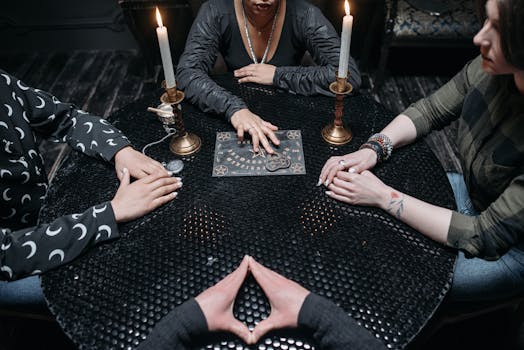
Those experience questions included seeing a UFO, reporting a ghost encounter, consulting a psychic, and using a Ouija board.
Importantly, participating in a paranormal activity is not the same as witnessing a verified supernatural event.
The researchers used statistical regression models to examine relationships between these different factors.
Although 2,100 people completed the original survey, the main statistical models included 1,088 respondents for paranormal beliefs and 1,111 for paranormal experiences after accounting for missing responses.
This distinction is important when interpreting the results.
1. Religious Supernatural Beliefs Were Strongly Connected to Paranormal Beliefs
One of the clearest findings involved people who believed in supernatural religious concepts.
Respondents who expressed stronger beliefs in angels, demons, heaven, hell, and similar religious ideas also tended to express stronger paranormal beliefs.
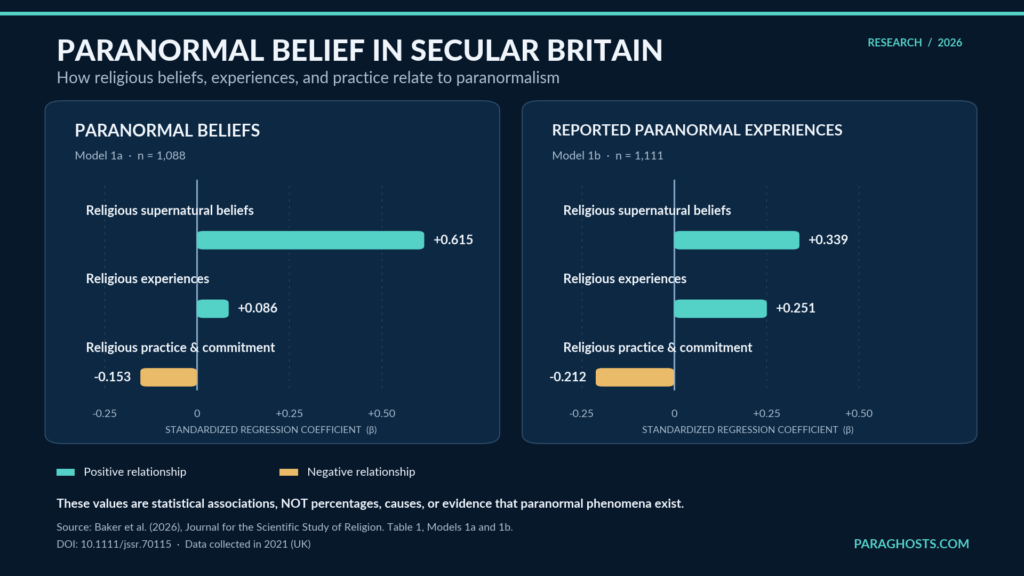
In the main statistical model predicting paranormal beliefs, religious supernatural belief was the strongest predictor.
Its standardized regression coefficient was β = 0.615.
This indicates a substantial positive statistical association within the model. It does not mean that 61.5% of religious believers believe in ghosts.
The finding suggests that people who accept supernatural explanations in one area of life may also be more receptive to supernatural explanations elsewhere.
For example, someone who believes that spiritual beings can interact with the physical world may consider a ghost encounter more plausible.
Another person might believe in angels while remaining skeptical of ghosts or psychic abilities.
The study does not suggest that everyone who believes in religion automatically believes in paranormal phenomena.
Instead, it identifies a broader relationship between different types of supernatural belief.
This helps explain why people believe in the paranormal even when those beliefs exist outside traditional religious teachings.
2. Stronger Religious Practice Was Linked to Lower Paranormal Belief
The research also uncovered a seemingly contradictory finding.
Although supernatural religious beliefs were positively associated with paranormalism, conventional religious practice showed a negative association.
In the main model predicting paranormal beliefs, religious practice and commitment had a standardized coefficient of β = -0.153.
The pattern was even stronger for reported paranormal experiences, where the coefficient was β = -0.212.
These results mean that people with stronger conventional religious practice and commitment tended to report fewer paranormal beliefs and experiences after other measured factors were considered.
Why would this happen?
One possible explanation involves the boundaries established by religious institutions.
Traditional religious communities often have specific teachings about acceptable and unacceptable spiritual practices.
For example, a religious person may believe in angels and divine intervention while rejecting psychic readings or attempts to communicate with spirits.
Another individual may interpret an unusual experience through religious doctrine rather than paranormal folklore.
The researchers suggest that organized religion can influence which supernatural explanations people consider acceptable.
This does not mean religious participation directly causes someone to reject paranormal beliefs.
The findings demonstrate a statistical relationship, not a proven cause.
Nevertheless, the distinction provides an important clue about how religious culture may influence paranormal belief.
3. Personal Supernatural Experiences Were Associated With Paranormalism
Another important part of the study involved reported supernatural experiences.
Researchers examined whether people who described unusual religious experiences were also more likely to report paranormal experiences.
These religious experiences included reports of miraculous healing, visions, hearing the voice of God, and other intense spiritual events.
The findings showed positive relationships between religious experiences and paranormalism.
For the model predicting paranormal experiences, reported religious experiences had a standardized coefficient of β = 0.251.
Religious supernatural beliefs also showed a positive relationship with reported paranormal experiences, with a coefficient of β = 0.339.
Both relationships were statistically significant.
These findings suggest that people who report unusual experiences within a religious setting may also be more likely to report experiences they understand as paranormal.
However, the study cannot determine whether the reported events had supernatural causes.
It measured what participants believed and reported experiencing.
That distinction is essential.
A person may sincerely describe an event as supernatural without researchers being able to determine what caused it.
The results are valuable because they reveal patterns in how people report and interpret extraordinary experiences.
4. Paranormal Belief Was More Strongly Connected to Supernatural Religion Among Those With Lower Religious Commitment
Perhaps the most revealing finding involved the interaction between religious belief and religious commitment.
Researchers discovered that the relationship between supernatural religious beliefs and paranormalism depended partly on how strongly people participated in conventional religion.
Among respondents with lower religious practice and commitment, supernatural religious beliefs were more strongly associated with paranormal beliefs and reported experiences.
Among people with greater conventional religious commitment, that positive association was considerably weaker.
In other words, someone may believe in supernatural forces while feeling little obligation to follow the teachings of an organized religious institution.
That individual may be more open to combining religious ideas with paranormal interpretations.
The researchers found statistically significant interaction effects involving religious belief, religious practice, and paranormal outcomes.
They also found that religious practice moderated the relationship between reported religious experiences and reported paranormal experiences.
However, not every interaction was statistically significant.
The interaction between religious experiences and religious practice did not significantly predict paranormal beliefs in one model.
This is an important qualification. The evidence supports several related patterns, but it does not establish that every form of religious experience operates identically.
Overall, the findings suggest that religious commitment may influence how different supernatural beliefs fit together.
What Is Bounded Affinity Theory?
To understand why people believe in the paranormal, it helps to examine the theory behind the research.
Bounded affinity theory explores the relationship between conventional religion and paranormal belief.
The basic idea is that religion and paranormalism share certain similarities.
Both may involve accepting the possibility of supernatural forces, spiritual beings, or events that fall outside established scientific explanations.
However, organized religions may establish boundaries around which supernatural beliefs their members should accept.
Consider two hypothetical individuals.
The first attends religious services regularly and follows the teachings of a faith community.
That person believes in spiritual beings but rejects psychic mediums because those practices conflict with their religious beliefs.
The second believes in spiritual beings but does not participate in organized religion.
That person may feel comfortable exploring ghosts, psychic phenomena, and other supernatural claims.
Both individuals accept some supernatural possibilities.
Their relationship with organized religion, however, may influence which additional claims they consider believable.
Bounded affinity theory provides a framework for examining this difference.
Why the Researchers Used the Term Unbounded Affinity
The 2026 study extends this theory into the increasingly secular cultural environment of the United Kingdom.
As participation in organized religion declines, some individuals may become less influenced by institutional teachings.
Their supernatural beliefs may become more personal and less restricted by established religious boundaries.
This is what the researchers describe as an unbounded affinity between religion and paranormalism.
The concept does not mean that paranormal beliefs are unlimited or that every person becomes more spiritual.
It describes how religious supernatural beliefs may coexist more freely with paranormal beliefs when conventional religious commitments are weaker.
The researchers argue that this may help explain the continued popularity of paranormalism in relatively secular societies.
Why Does Paranormal Belief Continue in Secular Britain?
One of the biggest questions surrounding the research concerns secularization.
Secularization generally refers to the declining social influence of organized religion.
It may involve fewer people identifying with religious institutions or participating in religious services.
However, declining religious participation does not necessarily mean that every form of supernatural belief disappears.
The researchers point out that organized religious affiliation has declined significantly in Britain over recent decades.
Their article cites earlier research showing that reported religious affiliation fell from 66% in 1984 to 47% in 2018.
Yet interest in ghosts, psychic phenomena, and other paranormal subjects has remained a recognizable feature of British culture.
A related 2025 study by Clark, Baker, and Bader reported that more than 70% of respondents in the UK survey held at least one paranormal belief.
That figure comes from the earlier analysis. It is not a newly measured prevalence estimate from November 2026.
Taken together, the research points toward an important distinction.
A society can become less religious in its institutions without becoming entirely secular in its supernatural beliefs.
Some people may leave organized religion while retaining beliefs about spirits, an afterlife, or unusual experiences.
Others may develop spiritual interpretations that combine ideas from different cultural traditions.
The 2026 study supports the view that religious belief and institutional religious commitment should be examined separately.
It does not prove that secularization itself causes paranormal belief to increase.
Does Believing in Ghosts Mean Someone Is Religious?
Not necessarily.
The research demonstrates that religion and paranormalism have a complicated relationship.
Some people identify strongly with organized religion and also believe in ghosts.
Others report paranormal beliefs while identifying as agnostic, atheist, or spiritual without belonging to a religious organization.
The study also examined differences between religious affiliations.
In one model, atheists reported lower paranormal belief scores than Church of England respondents after accounting for the other measured variables.
Certain other religious groups also showed different patterns.
These findings reinforce the idea that no single religious identity can explain paranormal belief.
What appears more informative is the combination of supernatural beliefs, personal experiences, and religious commitment.
Someone can believe in ghosts without believing in God.
Likewise, someone can believe deeply in God while rejecting ghost hunting, mediumship, or other paranormal activities.
Both positions are compatible with the broader statistical patterns found in the study.
How Personal Experiences Shape Paranormal Interpretations
Personal experience is an important subject for paranormal investigators.
People frequently describe unusual events that they believe cannot be explained through ordinary circumstances.
These reports may involve unexplained sounds, unusual visual experiences, apparent apparitions, or a feeling that something invisible is present.
The 2026 research did not investigate individual hauntings or test the authenticity of reported supernatural encounters.
Instead, it examined the relationship between different categories of reported experiences.
This matters because experiencing something unusual and explaining that experience are separate processes.
Imagine someone waking during the night and sensing a presence nearby.
One person might interpret the event as a ghost.
Another might describe a religious experience.
A third might consider sleep paralysis, a dream-related phenomenon, or another natural explanation.
The researchers discuss how cultural frameworks may influence interpretations of unusual experiences.
This offers an important lesson for paranormal research.
The meaning someone attaches to an experience can be influenced by personal belief, religious background, and cultural expectations.
Understanding those influences does not require dismissing the experience.
It means distinguishing between the event someone reports and the explanation proposed for it.
Why Do People Believe in Ghosts and Supernatural Experiences?
Why do people believe in the paranormal, even when scientific explanations are available?
In this educational video, psychology expert Christopher French explores how human perception, sleep paralysis, hallucinations, and the brain’s ability to recognize patterns can influence reported ghost encounters.
These explanations provide additional context for understanding paranormal belief and personal supernatural experiences.
Watch the Video Below:
What the Research Reveals About Ghosts, UFOs, and Psychic Beliefs
Although the study primarily focused on religion and paranormalism, its findings also have implications for understanding different paranormal subjects.
Ghosts and Hauntings
Ghost beliefs often involve the possibility of continued existence after physical death.
Some individuals connect these beliefs with religious teachings about spirits or an afterlife.
Others may view ghosts through folklore, personal encounters, or paranormal investigation.
The findings suggest that supernatural religious beliefs may be associated with greater openness to ghost beliefs.
However, this relationship does not establish whether ghosts exist.
UFOs and Extraterrestrial Encounters
The survey also included beliefs and reports involving UFOs and extraterrestrial visitation.
These subjects differ from traditional religious supernatural claims because extraterrestrial life is not necessarily supernatural.
Nevertheless, beliefs about alien visitation can fall within paranormal culture when they involve extraordinary claims that lack established evidence.
The study examined such beliefs as part of a broader measure of paranormalism.
It did not determine whether any reported UFO encounter involved extraterrestrial technology.
Psychic Phenomena and Spirit Communication
Psychic abilities, fortune telling, and spirit communication are especially relevant to the relationship between religion and paranormalism.
Some religious traditions discourage these practices.
Others may accept particular forms of spiritual communication.
The study’s findings suggest that organized religious commitment can help distinguish which extraordinary claims people accept or reject.
For researchers, this raises important questions about how personal spirituality influences belief in mediums, psychic abilities, and communication with the deceased.
Does This Study Prove That Paranormal Phenomena Are Real?
No.
This is one of the most important distinctions in the entire research.
The study examined statistically measurable relationships between beliefs, practices, and reported experiences.
It did not conduct controlled investigations into ghosts, spirits, psychic abilities, or extraterrestrial encounters.
It also did not independently verify the supernatural experiences described by respondents.
The researchers relied on survey responses.
Their results tell us how certain beliefs and reported experiences relate to one another within the surveyed population.
They do not identify the physical or supernatural causes of those experiences.
Important Limitations of the Study
Several limitations should be considered.
First, the study was observational. Researchers identified statistical associations rather than experimentally establishing cause and effect.
Second, the survey relied on self-reported information. People’s responses may reflect memory, interpretation, cultural expectations, or willingness to disclose personal beliefs.
Third, the research used data collected in 2021. Although the paper was published in 2026, its findings do not directly measure changes that occurred between those years.
Fourth, the survey covered people aged 16 to 75. The results should not automatically be extended to all age groups or other countries.
Finally, the statistical models used fewer participants than the original sample. This occurred because some responses were missing or excluded from particular analyses.
These limitations do not invalidate the findings.
They help establish what conclusions can reasonably be drawn from the evidence.
The study is valuable as peer-reviewed sociological research, but it should not be described as scientific confirmation of paranormal activity.
Why This Research Matters for Paranormal Investigators
For paranormal investigators, the study offers useful insights into the relationship between personal beliefs and reported experiences.
Investigators frequently encounter people with different religious backgrounds and explanations for unexplained activity.
One witness may believe a location is haunted by a deceased relative.
Another may interpret similar activity as a spiritual warning.
Someone else may believe the experience has an ordinary explanation.
The research provides a reason to take these differences seriously.
Belief systems may influence which explanations people consider possible.
This makes careful questioning especially important during paranormal investigations.
Investigators should document what witnesses experienced before asking them to identify a supernatural cause.
It is also useful to separate firsthand observations from interpretations offered afterward.
For example, recording that a witness heard three knocks is more precise than immediately describing the sound as communication from a spirit.
A responsible investigation should also consider environmental conditions, building materials, equipment problems, and other possible explanations.
The goal should be to understand the available evidence rather than force an experience into a predetermined explanation.
The new findings do not provide a method for identifying paranormal activity.
They provide a better understanding of the people who report and believe in it.
Why People Believe in the Paranormal: What the Evidence Suggests
The broader question of why people believe in the paranormal cannot be answered by a single study.
Human beliefs are shaped by many influences.
Personal experiences, religious teachings, family traditions, cultural stories, and social environments may all play a role.
The 2026 research adds evidence that different dimensions of religiosity relate to paranormalism in different ways.
Its central findings can be summarized in four observations.
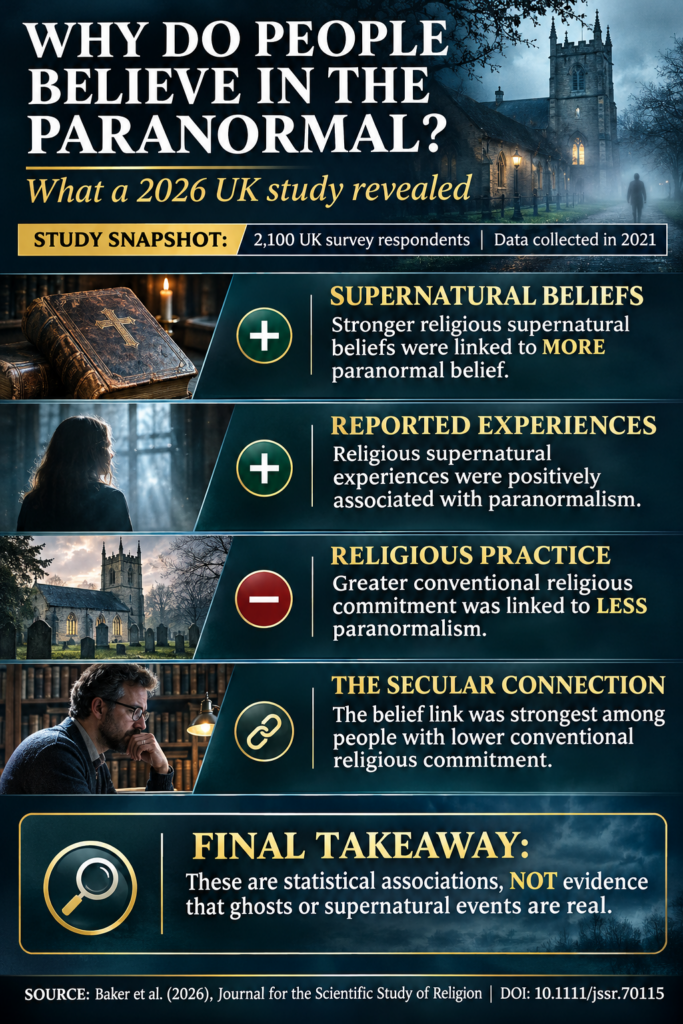
- Supernatural religious beliefs were positively associated with paranormal beliefs and experiences.
- Reported religious experiences were also positively associated with paranormalism.
- Stronger conventional religious practice and commitment were negatively associated with paranormal beliefs and reported experiences.
- Some positive relationships between supernatural religion and paranormalism were stronger among people with lower conventional religious commitment.
Together, these patterns help explain why supernatural belief can remain widespread in a society where organized religion has declined.
The findings also show why simple explanations can be misleading.
Being religious does not always predict paranormal belief in the same direction.
Neither does becoming less involved in religion necessarily mean abandoning every supernatural idea.
Can Paranormal Belief Continue Growing as Religion Declines?
The new research suggests that paranormal beliefs can remain culturally important in a secular society.
However, it does not establish that paranormal belief is increasing over time.
Determining whether paranormal belief is growing would require reliable comparisons across multiple periods.
The 2026 study instead provides a detailed examination of relationships present in its 2021 survey data.
Its contribution is showing how supernatural beliefs and religious practices can have different statistical relationships with paranormalism.
The researchers suggest that weakening institutional religious boundaries may allow people to combine spiritual and paranormal ideas more freely.
This interpretation provides an explanation for the continued appeal of the supernatural in modern Britain.
Whether similar patterns occur elsewhere, or continue changing over time, remains an important question for future research.
Conclusion: Paranormal Belief May Persist Even When Traditional Religion Declines
The November 2026 study offers an important contribution to understanding why people believe in the paranormal.
Its findings suggest that paranormal belief is not simply a substitute for organized religion.
Instead, the relationship involves several overlapping factors, including supernatural religious beliefs, personal experiences, and the strength of religious commitment.
People who accept supernatural religious concepts may also be more open to paranormal claims.
Yet strong participation in conventional religion may limit that openness by establishing boundaries around acceptable spiritual beliefs.
In a more secular society, those boundaries may become less influential for some individuals.
That provides a possible explanation for why interest in ghosts, psychic phenomena, and other unexplained subjects continues even as traditional religious participation declines.
The research does not prove that supernatural phenomena exist.
It does reveal something important about the persistence of supernatural belief in modern society.
As organized religion changes, people’s interest in the unexplained does not necessarily disappear. It may simply take different forms.
For paranormal researchers, that distinction is worth understanding.
Studying the people who report unexplained experiences may be just as important as studying the experiences themselves.
Peer-Reviewed Study: Unbounded Affinity: Religiosity and the Paranormal in the United Kingdom
Journal: Journal for the Scientific Study of Religion
Published: November 6, 2026
Direct Link: https://doi.org/10.1111/jssr.70115
Full Research Manuscript: https://eprints.whiterose.ac.uk/id/eprint/247926/
About the Author: Kevin Mack
Kevin Mack is the founder of Paraghosts.com, a paranormal investigator, researcher, and freelance writer with over 15 years of experience exploring ghosts, hauntings, supernatural phenomena, and unexplained mysteries.
His work focuses on paranormal investigations, eyewitness experiences, historical cases, scientific research, and the psychology of paranormal belief.
Through Paraghosts, Kevin combines firsthand investigative experience with documented evidence and peer-reviewed research to help readers better understand the unexplained.
His goal is to encourage critical thinking, responsible paranormal investigations, and an open-minded approach to exploring supernatural claims.
Sources and References
1. Baker, J. O., Bader, C. D., Clark, T., and Fahim, M. A. (2026).
Unbounded Affinity: Religiosity and the Paranormal in the United Kingdom.
Journal for the Scientific Study of Religion.
Published November 6, 2026.
2. University of Sheffield, White Rose Research Online (2026).
Unbounded Affinity: Religiosity and the Paranormal in the United Kingdom.
Accepted manuscript deposited November 12, 2026.
Read the full research manuscript
3. Harvard Dataverse (2026).
Replication Data for: Unbounded Affinity: Religiosity and the Paranormal in the UK.
Public research data and replication materials.
4. Clark, T., Baker, J. O., and Bader, C. D. (2025).
Marginalized, Secularized, and Popularized? The Prevalence and Patterns of Paranormal Belief in the United Kingdom.
The Sociological Quarterly.
Research Disclaimer: This article discusses peer-reviewed sociological findings about paranormal beliefs and reported experiences. Statistical associations do not establish supernatural causation or prove the existence of paranormal phenomena. Readers should distinguish documented research findings from theoretical explanations and personal interpretations.
Visit Paraghosts.com for More Paranormal Related Topics